 Back to the news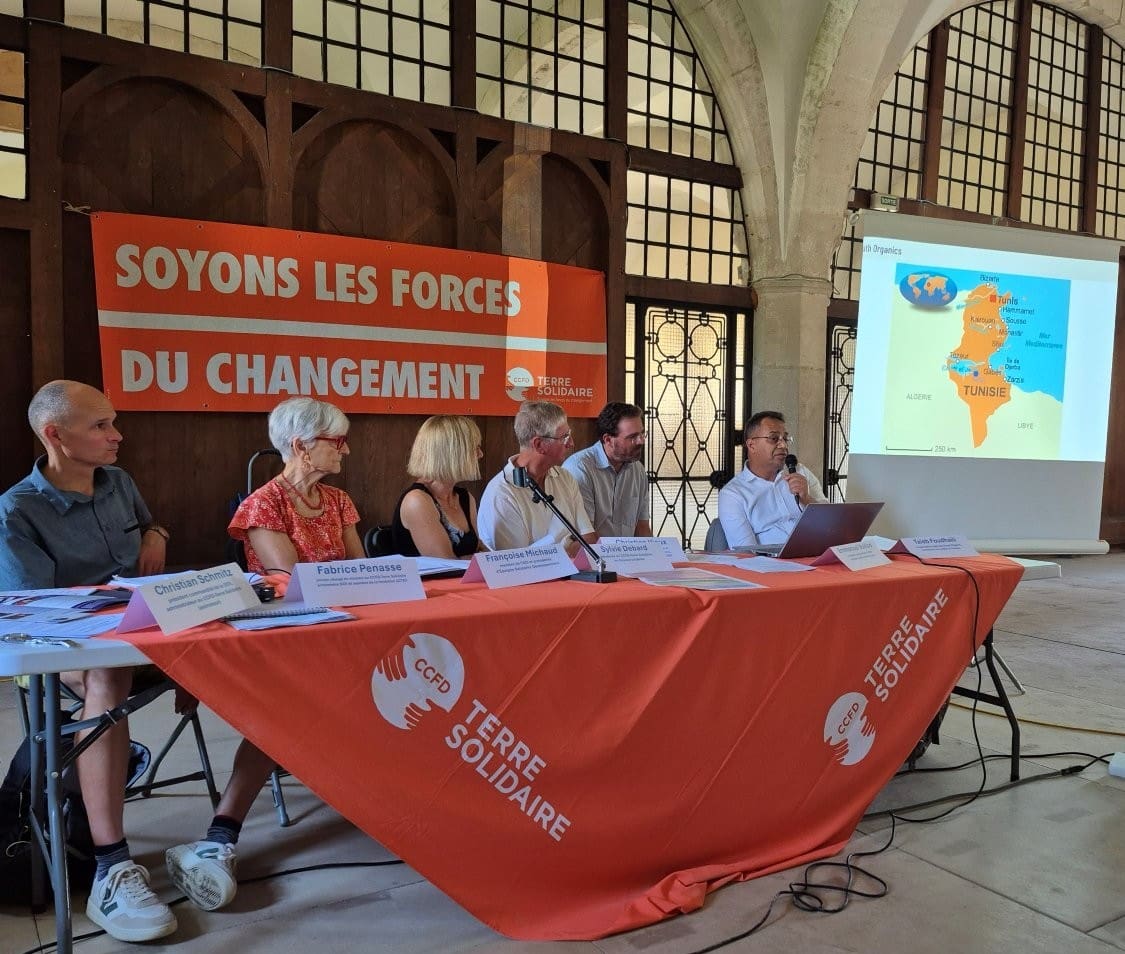
Our Tunisian partner, South Organic, was visiting France for a community event organized by CCFD-Terre Solidaire near Auxerre. Its founder also visited SIDI’s headquarters, providing an opportunity to ask him a few questions about the operations of this Kebili-based company that packages and markets organic and Fair Trade dates. South Organic has been a partner of SIDI since 2022.
Could you please introduce yourself and tell us more about South Organic?
My name is Taieb Foudhaili, and I founded South Organic in 2001—more than 25 years ago now. South Organic specializes in the export of organic dates from Tunisia. After the dates are harvested, South Organic manages the collection, sorting, processing, and transformation to ensure the final product meets our customers’ requirements.
Since its founding, South Organic has been committed to promoting organic farming, the socioeconomic development of the region’s residents, and environmental protection.
We work with more than 200 small-scale producers of certified organic and Fairtrade dates in the Kébili region. The date oases in this region consist of a maze of small, individual plots. The 227 farming families with whom South Organic works cultivate an average of just one hectare per family.
South Organic employs a large number of workers, particularly women, who make up more than 90% of our workforce. There are a total of between 100 and 120 permanent employees. Depending on the time of year and operational needs, our workforce can grow to as many as 250 people, or even 500 during harvest season. We receive orders year-round, so to meet our customers’ needs, there is virtually no downtime.
What challenges are you facing?
We have gone through some difficult times since 2020. First, there was the COVID-19 crisis, which led to a slowdown in exports. Then, the ensuing global economic crisis led, among other things, to a significant drop in demand. This had a major impact on our business.
In 2023, an environmental crisis compounded the situation: we experienced a severe drought that led to a surge in mite infestations, rendering the date crop unusable.
To address this type of problem caused by mite infestations during periods of drought, South Organic is implementing a preventive organic treatment plan applied twice a year. Unfortunately, due to the extreme drought and the far too rapid proliferation of mites, the preventive treatment plans were not sufficient. The farmers were desperate; it was a very difficult time for us.
It was easy for them to be tempted to use pesticides. At times like these, it’s difficult to convince farmers to continue farming organically, because pesticides can, at first glance, offer a quick and easier solution—despite all the harmful long-term effects they have on health and the environment.
It takes a long-term effort to change the way people see things.
Then, in 2024/2025, another challenge arose: Tunisia was hit by very heavy rains, putting the harvest at risk just as the dates had reached maturity. After all that hard work, an entire harvest could end up being unusable. The region hadn’t seen such heavy rainfall since 1969! In just one day, 70 ml of rain fell, whereas the annual average ranges from 100 to 150 ml. It was an exceptional situation.
This has led to financial difficulties, as we pre-finance the harvests to secure the income of organic date producers and our supply from South Organic. Unfortunately, with the damaged harvests, we have once again suffered financial losses.
By 2025, we had finally overcome the main challenges, even though there is still much work to be done. Little by little, all our hard work is finally paying off.
How is the partnership with SIDI going?
Our collaboration with SIDI and its Belgian counterpart, Alterfin—including through the FEFISOL II fund —has helped us weather these various challenges. In fact, since the COVID-19 crisis, we have stopped working with local banks.
Since then, we have succeeded in diversifying our customer base in a remarkable way. Previously, 65% of our production was exported; now, exports account for 85%. The remainder, which cannot be exported, is sold for livestock, for example.
What kind of support do you offer to producers?
First of all, it’s important to note that some of them have been working with us since South Organic was launched in 2001. We provide year-round support and assistance to producers through South Organic’s various services (internal audits, engineers, technicians, local assistants, inspectors, etc.).
Overall, organic date producers receive at least two training sessions each year. Our responsibility is to work closely with them.
Since March, we have also been testing new support methods: we are training “lead producers” who will themselves mentor 6 to 10 producers and coordinate between small-scale producers and the internal audit department. This obviously means extra work for these “lead producers,” who will receive allowances and bonuses. There will also be a rotation system: the lead producers will not be the same every year.
Drought seems to be a particularly difficult challenge to address: Are there any climate change adaptation projects?
Yes, we have been working on an ambitious irrigation system project. The goal is to improve water availability on small plots of land owned by farmers by providing a tank system.
To that end, it’s important to know that at South Organic, we have pilot plots where we test the necessary adjustments, adaptations, and innovations. With the support of our technicians, we have therefore conducted experiments on our own plots.
Each producer will have a storage pond of varying size, depending on the size of the plot. Sometimes, these ponds may be shared by several producers to reduce the investment cost of these facilities.
Another goal of adapting to climate change is diversification—particularly through vegetable crops and olive trees in palm groves. We’re currently starting to conduct trials on our pilot plot as well, and we hope to roll this out soon with our growers. But it takes time to get this up and running.
What was the purpose of your visit to France?
I attended the Festival du Bien vivre, organized by CCFD-Terre Solidaire Bourgogne–Franche-Comté on May 30 and 31 at Pontigny Abbey, near Auxerre.
I was invited to participate in the roundtable discussion on solidarity-based finance. It was a great opportunity to share South Organic’s experience with our producers. My goal was also to better understand the perspectives of people involved in these issues here in France. I had the chance to talk with quite a few volunteers from the network.
I enjoyed meeting people involved in solidarity-based finance. It’s important to me to build this connection because we live in different realities, where the date farmers in southern Tunisia seem far away. For me, participating in this event was a way to amplify their voices and build a bridge between the “South” and the “North.”
I was particularly moved by the commitment of everyone present and by the quality of the discussions. More broadly speaking, my role at South Organic aligns with this goal of coordination. Bridging the gap between the various roles in this supply chain is important—simply to “live better together” and achieve the goals of improving producers’ living conditions and compensation.
These conversations with volunteers here in France give me the strength and energy to keep working toward a better world. It gives me hope, honestly. We need that, because we’ve been through some really tough times, and everyday life isn’t easy.